
The Richest Man Ever to Have Lived
An attempt to place Elon Musk's trillions in a historical context

The below is an update of a magazine article I wrote in 2024, which was for various reasons never published. It was initially prompted by news that Elon Musk was on track to become a trillionaire by 2027. I was intrigued as to how that wealth sat within a historical context; and I was equally intrigued by Musk’s superfans — i.e. the men (all men) who abased themselves before him crying “we are not worthy!” As it turns out, Musk is due to become a trillionaire imminently, somewhat ahead of schedule. So I thought this deserved to see the light of day. Cocktails to follow at the usual time!
Richard
There are, in the opinion of Barney Whiter of Farnham, Surrey, two kinds of billionaire. There are your common or garden plutocrats: your inheritors of wealth, your corporate shills, your idle rich. He has no time for these people.
“The book shops are full of the biographies of mediocre CEOs,” says Whiter, his voice dripping with contempt. “Nonentities. Sir Terry Leahy of Tesco or whoever. Bullshit! You joined a corporation, you kissed the right arse, you got lucky, you collected a bunch of share options. Whoopee-fucking-doo.”
Whiter, a former accountant who now runs a personal finance site called The Escape Artist, finds it particularly “disgusting” when people “simp” for billionaires like Warren Buffett or Bill Gates, whom he thinks are “not particularly nice or well-balanced people.” But he makes an exception for Elon Musk, founder of SpaceX, investor in Tesla, purchaser of Twitter, main character of the internet. To him, Musk is different. “He is just in a league of his own as an entrepreneur, as a businessman, as a wealth creator,” says Whiter. “You cannot deny it.”
Elon Musk fans come in many varieties. There are those who love his cars. There are those who love his rockets. There are those who for some reason consider Musk to be an inspiring champion of free speech. But all of his fanboys (and they are almost without exception boys, even if they reside in the bodies of grown men) consider him to be in a category of his own. “Jeff Bezos just sits on his yacht,” says John Stringer, who runs a media channel called Tesla Owners of Silicon Valley. “That’s not Elon. Elon is literally working his butt off day in, day out. He’s a different type of billionaire.”
For Eric Mina, a YouTuber based in Scranton, Pennsylvania, the appropriate response is awe. “Look at all the things he’s accomplished!” he says. “He’s not trying to make a buck. He wants to be an interplanetary species and he’s actually going forward and doing it. That’s not the normal type of thinking that people have. They think: personal gain. He’s thinking bigger than that. So yes, he’s going to seem like he’s from another world.”
What’s interesting about these assessments is that as hyperbolic as they may be, they’re not entirely wrong. Elon Musk is indeed in a separate category from the other 2,700 or so billionaires on the planet (as estimated by Forbes) in many respects. One is quite simply that he is the richest of all of them. Indeed, assuming something doesn’t go catastrophically wrong with the SpaceX IPO — and there are plenty of reasons to think that it should — he will momentarily become the world’s first trillionaire. According to the Informa Connect Academy, which tracks the fortunes of the bariatrically wealthy, there are others on track to follow: the Indian tycoon Gautam Adani, the Indonesian mining magnate Prajogo Pangestu, the French luxury boss, Bernard Arnault, etc. But as with landing on Mars, one feels that being first is what counts.
But Musk is “a different type of billionaire” in other senses too. One is the fact that his power is not merely financial. His portfolio of interests cuts across technology, energy, transportation, space, communications, biotech and, of course, politics. As of 2020, SpaceX has provided NASA’s taxi service to the International Space Station. It is, as Musk reminded Joe Rogan in an interview last year, in the business of intercontinental ballistic missiles. “I invest in apocalyptic technologies, didn’t you know?” Then there are his Starlink satellites, which provide internet access to remote regions, including Ukraine. There is his Neuralink project, promising a brain-human interface. And there is X, formerly Twitter, which, despite a mass exodus of users since Musk’s takeover, remains the world’s most popular news site, a data source for his Grok large-language model, and a megaphone for Musk’s political views, which are basically Ayn Rand in Space with a strong flavour of post-Apartheid white resentment and, well, out-and-out fascism. He has 240 million followers, more than Cristiano Ronaldo, more than Taylor Swift, more even than Donald Trump whose presidential bid he vigorously supported, before accepting a job in his administration. The express intention of this was for Musk to destroy various parts of the public realm that he didn’t personally like — or which conflicted with his own ambitions.
For Guido Alfani, an economic historian at the University of Bocconi in Milan, this is all highly unusual from a world historical perspective. Alfani is the author of a history of the super-rich from antiquity to the tech age, Midas to Musk, if you will, entitled As Gods Among Men. He examines the power and influence of figures such as Alan Rufus, who commanded a fortune equivalent to £130 billion back in 11th century England, and the Gilded Age banker J.P. Morgan whose cash reserves were so vast, he was able to save America from a disastrous bank-run during the 1907 Knickerbocker Crisis. He has no qualms in asserting that Musk is the richest person ever to have lived.
He has no qualms in asserting that Musk is the richest person ever to have lived.
“Historically speaking, today’s super-rich are not only much wealthier in absolute terms but in relative terms too,” Alfani tells me. “If you compare Elon Musk’s wealth to the wealth of the median household in the US today, it is a much greater difference than, say, the difference between Cosimo de Medici and the average Florentine household in the mid-15th century.”
The main reason for this is to do with globalisation, he explains. Travel — and therefore trade — used to be really difficult. The wealth of the Medicis was geographically contained to the area around Florence with some limited trade overseas. Today, economic activity takes place on a global scale, which means more markets, more customers, more rewards. One way to look at that would be, in the past, every village had a rich person. Now we all live in one supersized global village, we all share the same rich people and they are accordingly supersized. (We share the same village idiots too).
So, according to Alfani, the emergence of a figure like Musk isn’t so surprising. The arc of history bends towards the rich becoming much richer with only occasional ruptures: the Black Death, the Second World War, say. Musk is only the latest, digital-age iteration of the trend and, he presumably hopes, its continuation: “I’m going to colonise Mars,” he is reported as saying in Walter Isaacson’s recent hagiography. “My mission in life is to make mankind a multiplanetary civilization.” Indeed, it is precisely this multiplanetary ambition that guides the $1.77 trillion valuation of SpaceX. Musk will become a trillionaire not because of what he has done but because of what he promises to do. As seasoned Musk-sceptic Brett Arends has noted, SpaceX actually loses about $2 million per hour; the only part of it that brings in proper revenue is Starlink, which basically amounts to a fancy mobile phone provider with about 10 million customers. The three main US mobile networks (Verizon, T Mobile and AT&T) have 40 times as many customers and 30 times as much revenue and are collectively valued at less than one-third of what SpaceX is valued. So why the $1.77 trillion valuation? Well the SpaceX prospectus promises investors this: “the establishment of a lunar economy and interplanetary industrialization… space tourism and cargo transport to the Moon … in-orbit manufacturing, passenger transport to the Moon, passenger and cargo transport to Mars, energy production on the Moon and Mars, manufacturing capabilities on the Moon and Mars, and asteroid mining.” Arends: “Many of these “initiatives” or dreams, the company admits, ‘involve significant technical complexity, unproven technologies, or technologies that do not exist or may require significant advancement, and such initiatives may not achieve commercial viability.’ In other words, the company plans to target markets that may not even exist using technologies it does not have.” Basically, Unobtanium. I wouldn’t necessarily bet on that one working out long term.
*
Still, even if one grants that a very significant proportion of Musk’s wealth derives from a) exploiting government subsidies/contracts and b) truly interstellar hucksterism, it’s hard seriously to maintain that he isn’t also an extremely impressive entrepreneur. There are, indeed, libraries worth of content parsing his teachings (“Always break down problems into their fundamental truths and reason from there”). Whether through his obsessive attention to detail or through mythmaking genius, he has, after all risen to the top of the dominance hierarchy of the age. However, what concerns Alfani is that in all past eras, there were more constraints on the men who did that. “In the Medieval and early modern period, well into the 19th century, there was much more of a divide between the political power of the nobility and the economic power of the commercial class. There has always been a suspicion of the rich getting involved in politics. That suspicion still exists —-but it’s exceptionally weak compared to the past.”
Nor did any figure of the past enjoy anything like the veneration that Musk inspires — such craven abasement, such we-are-not-worthy sycophancy. As Wil Waldon, a genial space enthusiast who presents the Elon Musk Podcast tells me: “There are people who - no matter what Elon does - they are going to follow him to the ends of the Earth. They would die for this guy. They think he can do no wrong.” He has had experience of this first hand. Waldon’s primary interests are space and cars; Musk is extremely consequential in both industries, but Waldon’s interest in him is downstream of his interest in engineering. But should he suggest on his podcast that SpaceX engineers such as William Gerstenmaier and Mark Juncosa maybe deserve a little more credit; or that the new Tesla Cyber Truck is less than a work of aesthetic bliss, he will be “destroyed in the comments.” Perhaps only Korean boy bands inspire such fervour.
Again, this kind of thing is new, says Alfani. In the Gilded Age through to the Roaring 20s, there was gossip, speculation, fictions about figures like John D. Rockefeller, J.P. Morgan and Andrew Carnegie. “But there was nothing like the same tendency to consider these people as superheroes or as models to be followed. This is new. And this connects to the fact that we’re more willing than at any other point in history to accept their direct involvement in politics.”
Alfani dates his own interest in the subject back to 1994, when Silvio Berlusconi, then Italy’s richest man, was elected Prime Minister. “At the time, this was unprecedented in a western democracy,” he says. Now, the idea of the extremely wealthy becoming either directly involved in politics as candidates (see Trump) or indirectly as cheerleaders (see Musk) has come to seem banal. Indeed, the average wealth of American gubernatorial and mayoral candidates has been rising for years. Of the many factors that cost Rishi Sunak the 2024 General Election, his being a centimillionaire by marriage was fairly low down on the list.
🥃Need a drink? Why here is my archive of approx. 200 cocktail recipes… 🥃
Should this concern the rest of us? Well, according to Oxfam, 60% of humanity has grown poorer since the Covid year of 2020, while the billionaire class has become 34% richer. The five richest men more than doubled their earnings in this period, adding $464 billion to their wealth. It’s no surprise that anti-billionaire politics is proving increasingly salient. This week’s launch of the Global Justice Fund by the star French economist Thomas Piketty and others — proposing a global wealth tax of 20% on billionaires — is one attempt to try and move from mere handwringing to a plan of action.
Ingrid Robeyns, a philosopher based at the University of Utrecht who has spent years studying the ethics of extreme wealth, believes we need to go much further. In her book Limitarianism, she makes many arguments against extreme wealth: it’s catastrophic for the environment; it engenders corruption; it’s not much good for the rich themselves, and indeed, Musk doesn’t exactly seem a model of contentment, does he? In fact, it’s a curious phenomenon that as angry as the billionaires seem to make ordinary people — ordinary people make the billionaires far angrier.
But one of the simplest arguments is quite simply that such disaprities of wealth are not fair. “There’s a deep philosophical argument that it is morally undeserved, because so much of what determines whether someone becomes extremely rich - not rich but extremely rich - are matters of luck,” she says. “Luck can never be a basis for moral reward.”
Our ancestors were arguably more clear-sighted about the connection between wealth and luck. It’s right there in the word “fortune”. In the past, wealth was more likely to be inherited rather than earned — a luck of birth. Actually, that’s still often the case: around one third of the Forbes billionaires are heirs. However, of the so-called “self-made” billionaires, there is still a widespread perception that their fortunes are natural byproducts of their ingenuity. “He is the ultimate example of meritocracy,” one Musk fan had insisted to me. “He started with nothing. Now he has multiple empires.”
Robeyns has little time for such arguments. “The distribution of income and wealth isn’t just the result of what individuals do, but also of our institutions. It’s to do with how we organise markets. Technology markets are winner-takes-all markets. But we’ve also seen a shift in the political economy that makes it much easier for them to accumulate their fortunes. The ideology legitimises their actions.”
Nor does she buy the argument that without Musk, we would be collectively impoverished: no electric cars, no spaceships, etc. “I have no problem responding to those arguments. I’ve heard them all before. The thing to ask is: what are all the companies that would have flourished if Musk had not built Tesla? Of course that’s a difficult counterfactual. It’s impossible for us to know what would have happened if Musk had not built Tesla or if the subsidies that went to him went to someone else. But if we judge the benefits of billionaires, that is the right question to ask.” Musk has, for example spent billions lobbying against an entirely practical and logical high-speed train link between Los Angeles and San Francisco and in favour of his own Hyperloop project — which, rather like the idea of mining asteroids, is ludicrous science fiction.
The aspect of this that concerns Robeyns most, however, is this ease with which financial power can be turned into political power. “Musk paid $44 billion to buy his own private social media platform, he financed it through selling his own shares, and he is using that platform in various ways to undermine democracy,” she says. “If you believe in the principle of political equality, you need to build very solid walls between the world of finance and the sphere of democracy.”
I try to put these arguments to Musk’s cheerleaders. It’s not entirely surprising that they are having none of it. “The whole trillionaire thing? What does that matter?” says Mina. “Anyone can be a trillionaire if you can push the stock up that high.”
Whiter feels that Musk’s achievements speak for themselves. “No one has rolled the dice as many times as him and every time he rolls a six.” Dice? Doesn’t that suggest that luck plays a role? He doesn’t think so. “Have you seen the videos of the Falcon coming into land?” He begins to laugh. “You don’t have to be an engineer to see that as a mindblowing feat without parallel in history. NASA has outsourced its entire space programme to one guy. It’s comparable to the US military hiring someone else to run the army!”
Isn’t that worrying? Some guy? Some extremely unstable guy? An entire space program? And how has he felt about Musk’s interventions into British politics? Musk has boosted the far-right hooligan Tommy Robinson, the ultranationalist Restore party and addressed a fascist rally in London via telescreen. You may recall that as violent racists trashed English towns last summer, Musk fanned the flames, spreading misinformation and conspiracy theories, tweeting “civil war is inevitable” and attacking Keir Starmer.
Whiter thought all that was brilliant. “I mean, dude. Yeah. Elon Musk is facing down the UK Prime Minister. He’s completely unafraid of the head of state of a G7 country!”
I can think of a couple of things to worry about here. But whatever one thinks of Starmer he is, in the end, beholden to the British public. Musk is a foreign billionaire beholden to no one but his shareholders. Why would a member of the British public be #teamshareholder? “Because his courage is off the scale. And we live in a world in which courage is in short supply. You cannot deny the guy has got massive balls. You can have whatever opinion you want about the things he believes. But you cannot say that Elon Musk isn’t fearless.”
*
The Harvard historian Jill Lepore coined the term Muskism1 to describe Musk’s peculiarly apocalyptic worldview, which coalesced when he was growing up with an abusive father in Apartheid South Africa and he sought refuge in superhero comics and science fiction. Muskism is “an extreme, extraterrestrial capitalism, where stock prices are driven less by earnings than by fantasies from science fiction,” she has argued. It is clearly a huge part of his image. Musk has consistently positioned himself as a character from a Marvel comic or Star Trek. At the same time, he is well versed in geek lore which just happens to be the lore of the internet. He jokes, he memes, he positions himself on the side of fun. He commands the village square. At one point during the Joe Rogan interview, Rogan remarked how wild it is that the Taliban is now on Twitter. “I always think,” says Musk, breaking into song: “Hey Mr Taliban, tally-me banana”. He is an unparalleled provider of content.
But another way that he is in tune with the internet is the way that despite his stratospheric wealth and success, he positions himself as an outsider, an underdog, a victim. This is how John Stringer of the Tesla fanclub sees him, anyway — as a victim of unfair discrimination and criticism. “The Biden administration has attacked him. It snubbed him. They didn’t even invite him to the EV summit in 2021!” The fact that Musk makes billions from government contracts doesn’t change the assessment. Musk is, in his eyes, doing the government - all of us! - a favour. “His companies are doing the most for humanity out of any companies on the planet. People think of him as the richest person in the world… But I have that history with him.”
And sure, most superfans will concede that his desire to populate the world with mini-versions of himself like some Techno Genghis Khan is peculiar. But so what? “Is he the nicest person? No! He says it himself,” says Mina. “He has Asperger’s which means he has not so good interpersonal skills. He’s going to look weird to an emotion-oriented person. You can hear it from his ex-wives. But he wants to create something that’s never been created. And if you’re going to make an omelette you’re going to have to break some eggs.”
Still, there are others who feel a little moderation is due. Waldon began to feel misgivings around 2018, the year of the infamous “pedo” libel, and now says that he is deeply conflicted. “He always posted a lot and generally the tone was aspirational. It was about this lovely collective of humanity moving to this better place. Recently he has been pushing more of an agenda. Some people love the rage. Personally? I just want the old Elon back.” Or as one Reddit user put it: “I’ll always miss the Elon Musk I thought was there.”
Then again, so multifarious are Musk’s activities, you can make almost any case for or against him at any time. I would imagine that Robeyn might feel a little hopeless, ranging philosophical arguments against a person like Musk who prides himself on his achievements in the physical world. She isn’t pessimistic, however. She believes that some form of wealth tax — some epochal realignment — will eventually happen. “You have to ask what will happen if we don’t regulate the rich,” says Robeyns. “What made us tolerate the super-rich in the past was that in times of crisis, they were willing to chip in and help the collective. They are no longer doing that.”
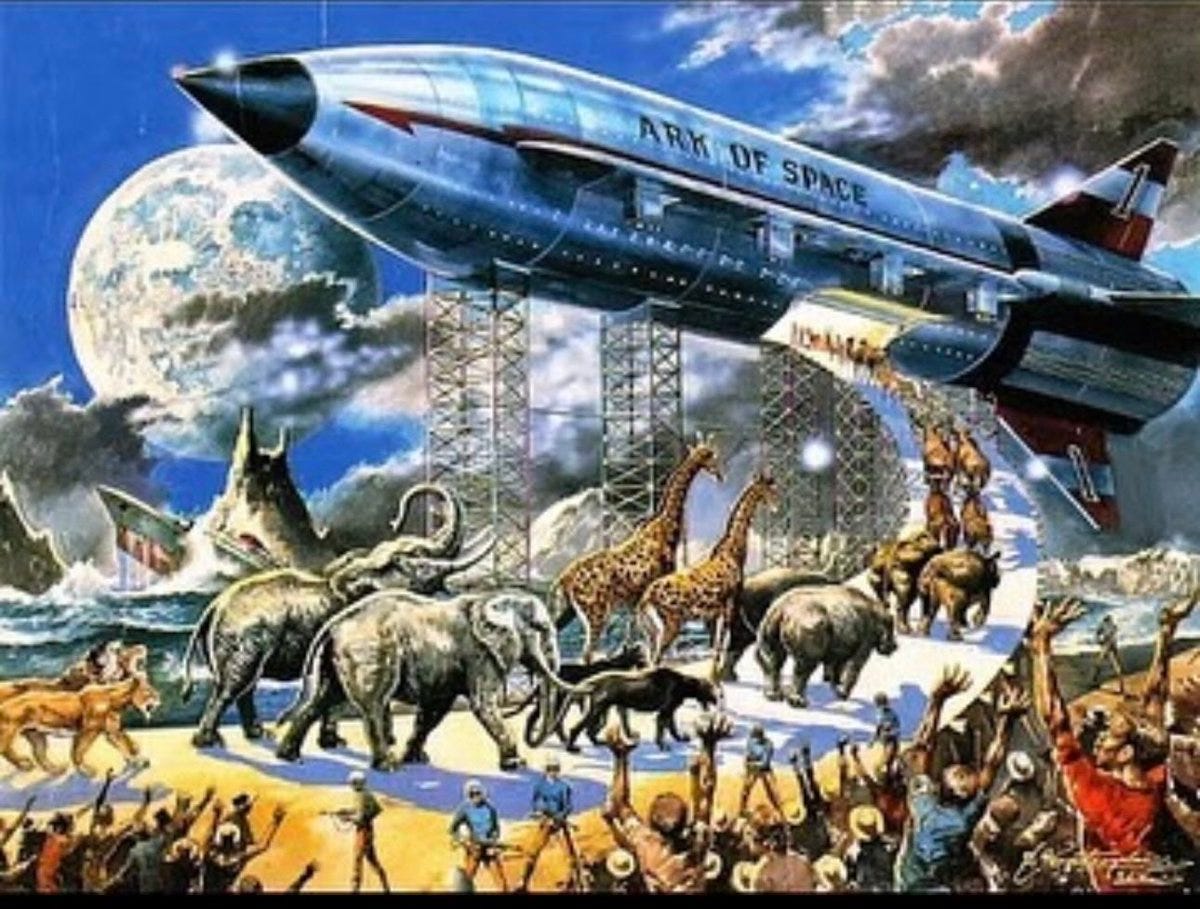
I know exactly what a Musk superfan would say to that. They would say, but he is saving humanity! He’s taking us to space! Robeyns directs my attention to a meme of Musk’s which depicts armed guards holding back a crowd of desperate, apparently non-white humans as animals board an “Ark of Space”. “‘Starship takes beings of Earth to Mars’, was Musk’s caption.
It was a joke. But as so often with Musk, maybe it also wasn’t a joke. “When he talks about what’s he’s doing for ‘all of us’, who is this all of us?” asks Robeyns. “The rhetoric that he’s spreading on X is not about all of us as equals.”
But his admirers don’t seem to see themselves as his equal. They see themselves as his inferiors. They see all of us as his inferiors. And they’re happy with that; happy merely to live on the same planet as such a God. I ask Whiter if he takes inspiration from Musk in his own life. “No,” he responds, testily. “He’s a genius. I’m not a genius. It’s like a dog comparing itself to a human.”
And yet Musk is a human, isn’t he? A peculiar human. A gifted human. But in the end, a flawed human operating in a flawed system, just like any of us. I wonder, will he continue to admire Musk whatever he does?
“That’s retarded,” he shoots back. “Then you’re in a cult.”
It’s impossible to know for sure for all kinds of reasons, but I would like to believe that Mansa Musa, the 14th Century ruler of Mali, was wealthier in real terms than Musk, as well as less pernicious. Yes he may have done significant damage to the Egyptian economy while staying near Cairo with his entourage en route to completing the Hajj, but that was never his intention. He was just giving large quantities of gold to the poor people he encountered along the way. I can’t see Musk being similarly philanthropic.
Great post