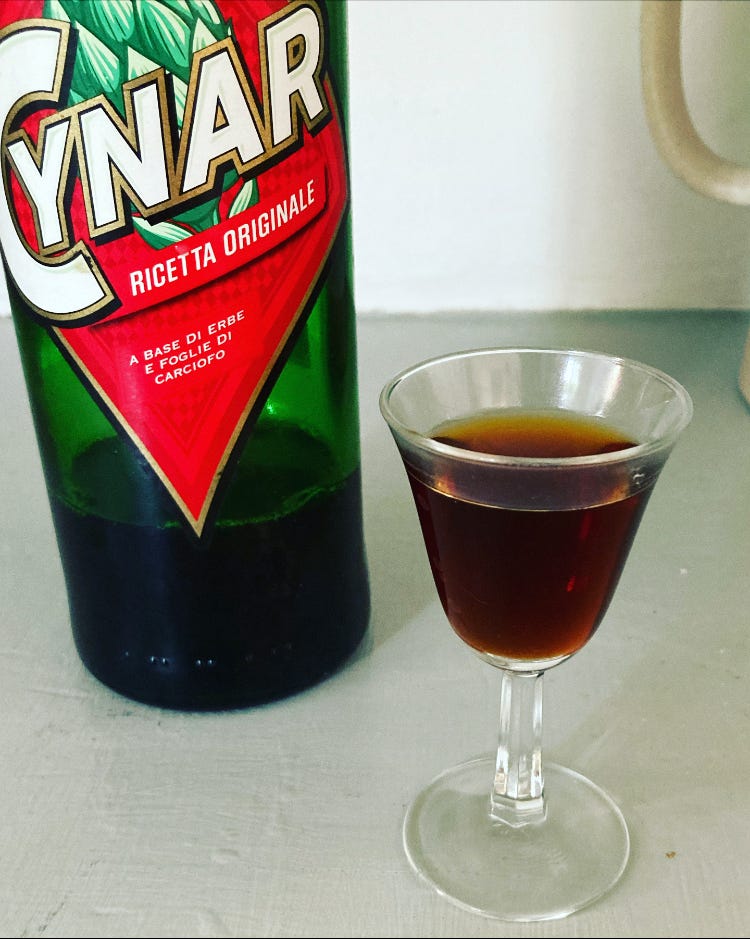
The Cabinet: Cynar
Contro il logorio della vita moderna
~ CYNAR ~
Amaro. 16.5% ABV, ~£15 for 700ml
Friends with: gin, rum (light and dark), bourbon/rye and aggressively flavoured spirits like mezcal, cachaca and aquavit. Italian vermouth is a great bridge for it, as is maraschino. And Cynar always matches with earthy flavours, like cinnamon, coriander, chocolate and bitter orange. Goes particularly well with sherry too.
Cynar - pronounced CHI-NAH - is an extremely useful bitter liqueur invented comparatively recently, in 1952, as a remedy for the angst of modernity. I reach for it all the time. It’s one of the bottles I replace most often and happily, there is an old-school Italian deli near me (Licata & Sons, Picton St, Bristol) that never runs out. It is part of a family of drinks known by the Italian name amari (amaro is the singular version). Traditionally, amari are made by infusing grape brandy (or a neutral alcohol) with various barks, spices and herbs and then adding sugar and, in some cases, ageing for a while.
There are approximately 3,583 amari but for cocktail purposes, I reckon we simplify it to two basic kinds. There’s the “aperitivo” family, including the Italian stalwarts Campari and Aperol (plus the French Suze), which are generally used in appetite-whetting pre-dinner drinks, like the Spritz and the Negroni.
And then there’s the “digestivo” family: Averna, Ramazzotti, Nonino and Montenegro are the famous Italian brands. Classically, these will be served after-dinner, to help your cacio e pepe go down. Fernet-Branca (worth a future post in itself) is also an amaro, albeit a very idiosyncratic one. And there are various non-Italian amari too, which are used in more or less the same way, with local variations. See: Jägermeister (German), Becherovka (Czech), Unicum (Hungarian), Gammeldansk (Danish), Balsam (Latvian) etc. They’re usually a bit love-it-or-hate-it and, as such, quite hip. I heard of a New York wedding that featured an amaro bar recently.
ANYWAY: Cynar? I think of it as an easy-going envoy between the pre- and post- dinner camps. (The French Amer Picon is similar in this respect). It works wonderfully in brooding after dinner drinks, notably Manhattan-variations like the Little Italy (see below). But it’s lighter and less syrupy than your standard amaro and works wonderfully at apero time, too; indeed, I reckon you could use it in place of Italian vermouth at a push. I first encountered it at a bar in Rome, where if you ordered a Spritz, you had a choice: Aperol, Campari or Cynar (NB: all three are made by Gruppo Campari). And its versatility has made it a great favourite among craft bartenders, particularly at the Violet Hour in Chicago [RIP!], where three of the recipes below were first dreamed up.